
Seismic Consolidation
Menu
  • HOME
  • Basic Civil Engineering
    • Civil Engineering Drawing
    • Civil Engineering Construction and Graphics
    • Surveying and Leveling
    • Basic Electrical Technology
    • Computer Programming
    • Applied Mathematics
    • Probability and Statistics
    • Numerical Analysis
    • Engineering Geology
    • Dictionaries
    • Technical Writing
  • Structural Engineering
    • Construction Materials
    • Engineering Mechanics
    • Mechanics of materials
    • Structural Analysis
    • Plain and Reinforced Concrete
    • Steel Structures
    • Structural Mechanics
    • Structural Engineering
    • Design of Structures
    • Properties of structural materials (M.Sc.)
    • Structural Analysis (M.Sc.)
    • Steel structures (M.Sc.)
    • Reinforced Concrete Structures (M.Sc.)
    • Prestressed concrete (M.Sc.)
    • Seismic design of structures (M.Sc.)
  • Geotechnical Engineering
    • Geotechnical Engineering
    • Pavement and Foundation Engineering
    • Geotechnical Investigation
  • Transportation Engineering
    • Transportation Engineering
    • Pavement analysis and design
    • Geometric design and highway safety
    • Transportation planning and engineering
    • Advanced traffic engineering
  • Hydraulics & Irrigation Engineering
    • Hydrology
    • Fluid mechanics
    • Hydraulics Engineering
    • Irrigation Engineering
    • Irrigation Engineering & Practices
    • Applied Hydrology (M.Sc.)
    • Hydraulics Structures
    • Advanced Fluvial Hydraulics
    • Hydropower Engineering
    • Sediment Transport
    • Application of RS & GIS in civil engineering
  • Environmental Engineering
    • Environmental engineering (sewerage network)
    • Environmental Engineering (water supply network)
  • Construction Management
  • Intermediate
    • Intermediate Part I Mathematics solution
    • Intermediate Part II Mathematics Solution
    • Intermediate Physics and Mathematics test series
  • Competitive Exams
  • Softwares
  • Past Papers
  • Civil Engineering Objective
  • Turnitin Plagarism Report
  • Membership
Menu

Determination of tensile strength of concrete by Split cylinder test:

Posted on February 15, 2020 by mianusman.iftikhar@hotmail.com
Spread the love

Job # 12:

Determination of tensile strength of concrete by Split cylinder test:

(ASTM C 496/C 496 M-04)

Significance:

  • This test method is used for the determination of splitting tensile strength of cylindrical concrete specimen.
  • Splitting tensile strength is generally greater than the direct tensile strength and lower than the flexural strength (modulus of rupture).
  • Splitting tensile strength is used in the design of structural light weight concrete members to evaluate the shear resistance provided by concrete and to determine the development length of the reinforcement.

Apparatus:

  1. Denison Leeds, England Compression testing machine
  2. Testing Samples
  3. Bearing strips

Related theory:

Difficulties in measurement of tensile strength:

There are considerable experimental difficulties in determining the true tensile strength of concrete. In direct tension test following are the difficulties:

  1. When concrete is gripped by the machine it may be crushed due the large stress concentration at the grip.
  2. Concrete samples of different sizes and diameters show large variation in results.
  3. If there are some voids in sample the test may show very small strength.
  4. If there is some initial misalignment in fixing the sample the results are not accurate.

Indirect methods for the determination of tensile strength of concrete:

  1. Split cylinder test
  2. Double punch test
  3. Modulus of rupture test

Split cylinder test:

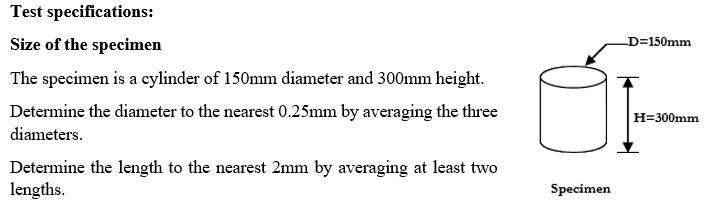
This test is performed by loading a standard 150mmФ x 300mm cylinder by a line load perpendicular to its longitudinal axis with cylinder placed horizontally on the testing machine platen.

The tensile strength can be defined as

T = 2P / (Π DL)

Where
P =  Total value of line load registered by machine
D =  Diameter of concrete cylinder
L =  Cylinder height

Mean split cylinder strength is approximately 0.53√fc’
Rate of loading

The rate of loading should be such that a stress of 0.7 – 1.4 MPa/min is produced.

Procedure:

  • This test method consists of applying a diametrical force along the length of a cylindrical concrete at a rate that is within a prescribed range until failure. This loading induces tensile stresses on the plane containing the applied load and relatively high compressive stresses in the area immediately around the applied load.
  • Although we are applying a compressive load but due to Poisson’s effect, tension is produced and the specimen fails in tension. Tensile failure occurs rather than compressive failure because the areas of load application are in a state of triaxial compression, thereby allowing them to withstand much higher compressive stresses than would be indicated by a uniaxial compressive strength test result.
  • Thin, plywood bearing strips are used to distribute the load applied along the length of the cylinder.
  • The maximum load sustained by the specimen is divided by appropriate geometrical factors to obtain the splitting tensile strength.

Observations and Calculations

Age of cylinders = 28 days

Diameter of cylinder = 150 mm

Length of cylinder = 300 mm

1 Ton = 2240 lb

1 lb = 4.45 N

Specimen no. Length (L) Diameter (D) Maximum applied load (P) Split tensile strength

T = 2P / (Π DL)

mm mm Ton N MPa
1 300 150 15.25 152012 2.15
2 300 150 15.75 156996 2.22
Mean strength 2.19


Results:

Splitting tensile strength = 2.19 MPa

Comments:

  • This is an indirect method of finding the tensile strength of concrete.
  • the tensile strength obtained by this method is very close to the tensile strength obtained from double punch test which is about 2.73 MPa.

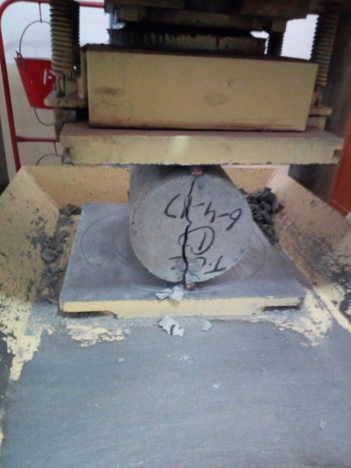
Sample during test:
 

Leave a Reply Cancel reply

Your email address will not be published. Required fields are marked *

Recent Posts

  • Assistant executive engineer (Civil) FPSC PWD Past paper 2020

    Assistant executive engineer (Civil) FPSC PWD Past paper 2020

    4 months ago
  • Assistant Executive Engineer PWD FPSC Past paper 2019

    Assistant Executive Engineer PWD FPSC Past paper 2019

    4 months ago
  • Assistant Director Engineering (Civil) Gujranwala Development Authority PPSC

    Assistant Director Engineering (Civil) Gujranwala Development Authority PPSC

    4 months ago
  • Assistant Executive Engineer (Civil) FPSC Railway Past Paper

    Assistant Executive Engineer (Civil) FPSC Railway Past Paper

    4 months ago
  • Municipal Officer (Infrastructure & Services) PPSC

    Municipal Officer (Infrastructure & Services) PPSC

    4 months ago
Seismic Consolidation

Recent Comments

  • hd film izle on Assistant executive engineer (Civil) FPSC PWD Past paper 2020
  • 먹튀검증사이트 on PENETRATION TEST ON BITUMINOUS MATERIALS
  • Ibraheem Mushtafa on Turnitin Plagarism Report
  • full hd izle on Assistant executive engineer (Civil) FPSC PWD Past paper 2020
  • filmi full izle on Assistant executive engineer (Civil) FPSC PWD Past paper 2020

Archives

  • October 2020
  • September 2020
  • August 2020
  • May 2020
  • April 2020
  • March 2020
  • February 2020
  • January 2020

Meta

  • Log in
  • Entries feed
  • Comments feed
  • WordPress.org
January 2021
M T W T F S S
 123
45678910
11121314151617
18192021222324
25262728293031
« Oct    
About Us
Contact Us
Privacy policy
Terms and Conditions
Disclaimer
DMCA
CCPA - California Consumer Privacy Act
Cookie Policy
©2021 Seismic Consolidation | Built using WordPress and Responsive Blogily theme by Superb