
Job # 4:
To perform LOS ANGELES Abrasion test on aggregate
Code description:
ASTM C 131/C 131 M-14 and AASHTO T-96
Scope & Significance:
This test method covers a procedure for testing of coarse aggregates for resistance to degradation using the Los Angeles Abrasion testing machine.
- Due to the movement of traffic, the road stones used in the surfacing course are subjected to wearing action at the top. Resistance to wear or hardness is hence an essential property for road aggregates, especially when used in wearing course. Thus, road stones should be hard enough to resist the abrasion due to traffic. When fast moving traffic fitted with pneumatic tyres move on the road, the soil particles present between the wheel and road surface causes abrasion on the road stone. Steel tires of animal drawn vehicles, which rub against the stones, can cause considerable abrasion of the stones on the road surface. Hence in order to test the suitability of road stones to resist the abrasion action due to traffic, tests are carried out in the laboratory.
- Los Angeles abrasion test is used to find out the % wear due to relative rubbing action between aggregate and steel balls used as abrasive charges. Pounding action of these balls also exists while conducting the test. The test is considered more dependable as rubbing and pounding action simulate field conditions.
Related theory:
Abrasion:
“Resistance of a material against wear, scratching or degradation is known as abrasion”
Pounding action:
“Striking action of an object on a surface for a short instant of time is called pounding action”
Los Angeles Abrasion test:
The principle of Los Angeles abrasion test is to find the percentage wear due to relative rubbing action between aggregates and steel balls used as abrasive charge. The pounding action of these balls also exits while conducting the test. Some investigators believe this test to be more dependable as rubbing and pounding action simulate the field conditions where both abrasion and impact occur. Los Angeles abrasion test has been standardized by the ASTM and AASHTO. Standard specifications of Los Angeles abrasion values are also available for various types of pavement constructions.
Los Angeles abrasion value:
“It is an indicative of the abrasion strength of the aggregates”
It can be computed by using the relationship:

Loss Angeles Abrasion machine:
It consists of a hollow steel cylinder closed at both ends, having inside diameter of 28” and length of 20”. The cylinder is mounted on stub shafts in such a way that it rotates about horizontal axis at 30-33 rpm.
An opening in cylinder with dust tight cover is provided for the introduction of test sample. A steel shelf extending full length of the cylinder and projecting 3.5” inward is mounted on interior surface of the cylinder.
The machine should be driven to produce 30-33 rpm.
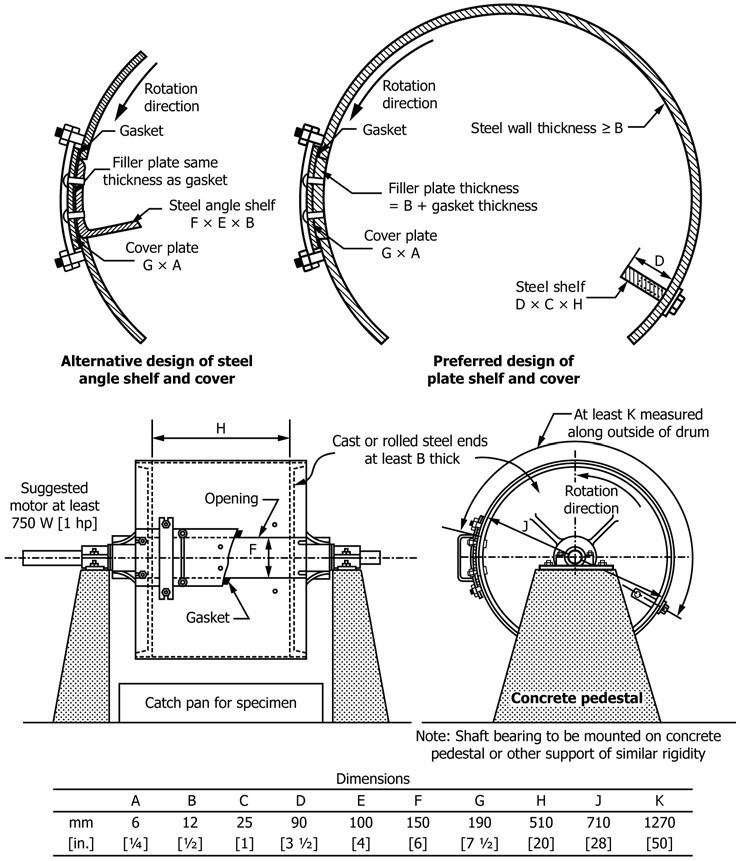
Los Angeles testing machine
Apparatus:
- Los Angeles Abrasion machine
- Coarse sieve shaker including standard sieves sizes
- Weighing balance
- Sieve # 12
- Abrasive charges, Ø = 1 27/32”, m =390-445g, approximately 439.6g
Procedure:
- Sieve the sample in the coarse sieve shaker.
- Clean the aggregates and dry them in an oven at 105-110°C to constant weight. Conforming to anyone of the grading A to D or 1-3 as per table (a).
- The grading or gradations used in the test should be nearest to the grading to be used in the construction.
- Aggregates weighing 5 kg for grading A. B, C or D and 10 kg for grading 1, 2, or 3 may be taken as test specimen and placed in the testing cylinder.
- The abrasive charge is also chosen in accordance with table (b) depending on the grading of the aggregate and is placed in the cylinder of the machine.
- The cover is then fixed dust-tight.
- The machine is rotated at a speed of 30 to 33 revolutions per minute.
- The machine is rotated for 500 revolutions for gradations A. B, C and D, for gradations 1,2 and 3, it shall be rotated for 1,000 revolutions.
- The machine should be balanced and driven in such a way as to maintain uniform peripheral speed.
- After the desired number of revolutions, the machine is stopped and the material is discharged from the machine taking care to take out entire stone dust.
- Using a sieve # 12, the material is sieved and the material that is retained on sieve 3 12 is weighed.
Table (a) Grading of test samples:
| Sieve Size (Square Openings) | Mass of Indicated Sizes, g | ||||||||
| Passing | Retained on | ||||||||
| A | B | C | D | 1 | 2 | 3 | |||
| 76.2 mm (3 in) | 63.5 mm (21⁄2 in.) | … | … | … | … | 2 500 ± 50 | … | … | |
| 63.5 mm (21⁄2 in.) | 50.8 mm (2 in) | … | … | … | … | 2 500 ± 50 | … | … | |
| 50.8 mm (2 in) | 37.5 mm (11⁄2 in.) | … | … | … | … | 5 000 ± 50 | 5 000 ± 50 | … | |
| 37.5 mm (11⁄2 in.) | 25.0 mm (1 in.) | 1 250 ± 25 | … | … | … | … | 5 000 ± 25 | 5 000 ± 25 | |
| 25.0 mm (1 in.) | 19.0 mm (3⁄4 in.) | 1 250 ± 25 | … | … | … | … | … | 5 000 ± 25 | |
| 19.0 mm (3⁄4 in.) | 12.5 mm (1⁄2 in.) | 1 250 ± 10 | 2 500 ± 10 | … | … | … | … | … | |
| 12.5 mm (1⁄2 in.) | 9.5 mm (3⁄8 in.) | 1 250 ± 10 | 2 500 ± 10 | … | … | … | … | … | |
| 9.5 mm (3⁄8 in.) | 6.3 mm (1⁄4 in.) | … | … | 2 500 ± 10 | … | … | … | … | |
| 6.3 mm (1⁄4 in.) | 4.75-mm (No. 4) | … | … | 2 500 ± 10 | … | … | … | … | |
| 4.75-mm (No. 4) | 2.36-mm (No. 8) | … | … | … | 5 000 ± 10 | … | … | … | |
| Total | 5 000 ± 10 | 5 000 ± 10 | 5 000 ± 10 | 5 000 ± 10 | 10 000 ± 100 | 10 000 ± 75 | 10 000 ± 50 | ||
Table (b) No. of abrasive charges for the above grading:
| Abrasive charges | No. of revolutions | No. of spheres | Weight of charges |
| g | |||
| A | 500 | 12 | 5 000 ± 25 |
| B | 500 | 11 | 4 584 ± 25 |
| C | 500 | 8 | 3 330 ± 20 |
| D | 500 | 6 | 2 500 ± 25 |
| 1 | 1000 | 12 | 5 000 ± 25 |
| 2 | 1000 | 12 | 5 000 ± 25 |
| 3 | 1000 | 12 | 5 000 ± 25 |
Observations & Calculations
Grading used for the test = B
Number of abrasive charges used = 11
Original weight of sample, = 5 000g
Final weight of sample that is retained on sieve # 12, = 3 773g

Limiting values of LAA:
Larger the LAA value, softer will be the aggregate and smaller the value, harder will be the aggregate.
For wearing surface use the value 10 % from (0% – 10%), this is because even though 0 % will provide a good hard surface but its coefficient of friction will be too high that it will severely damage the tires.
For sub grade, sub base and base coarse, provide aggregate of lower LAA value to provide hardness.
According to AASHTO T 96:
For sub-base, the coarse aggregate should have a % wear by the Los Angeles abrasion not more than 50 %
For base coarse, the coarse aggregate should have a % wear by the Los Angeles abrasion not more than 40 %
Comments:
The LAA value of our sample is 25 %, hence it can be used in sub base, base coarse and wearing surface.